
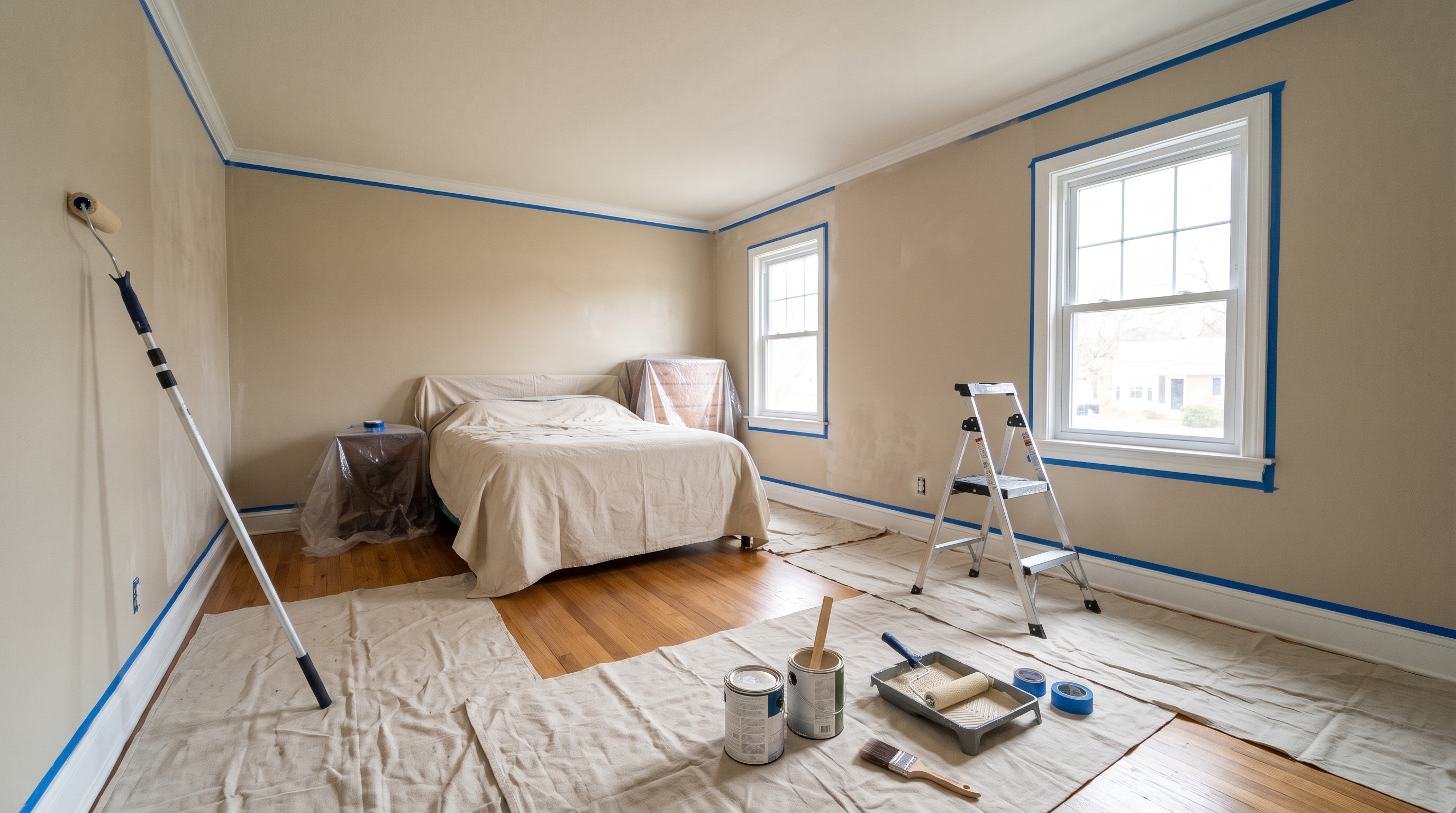
Quick Answer: To paint the walls of a 12x14 bedroom with a 9-foot ceiling, plan on 2 gallons plus 1 quart (or 3 full gallons for textured walls, dramatic color changes, or touch-up reserves) for two finish coats. Add 1 gallon of flat ceiling paint for the 168-square-foot ceiling and 1 quart of semi-gloss enamel for baseboards and door/window trim.
A standard 12x14 room with 9-foot walls sits right on a frustrating paint-buying threshold: the net paintable wall area lands right around 400 square feet, which means two coats require roughly 800 square feet of coverage. On paper, two gallons sounds like enough. In practice, a single absorbent wall or a thicker roller nap will leave you half a wall short on Sunday afternoon.
> Have a different closet layout or extra windows? Plug your exact wall lengths, ceiling height, and openings into our [Room Paint & Primer Calculator](/paint-calculator.html) to get a custom gallon count in seconds.
Quick Paint Breakdown: 12x14 Bedroom (9ft Ceiling)
The table below assumes standard smooth drywall, two finish coats, and typical bedroom openings (one entry door, one closet door, and two standard windows).
| Surface | Net Paintable Area | Coverage Needed (2 Coats) | Recommended Purchase | Best Finish / Sheen |
| :--- | :--- | :--- | :--- | :--- |
| Walls (Smooth, Similar Color) | ~398 sq ft | ~796 sq ft | 2 Gallons + 1 Quart (minimum 2 gal) | Eggshell or Matte |
| Walls (Textured or Dark-to-Light) | ~398 sq ft | ~796 sq ft | 3 Gallons (plus 1.5–2 gal primer) | Eggshell or Satin |
| Ceiling (12 × 14 ft) | 168 sq ft | 336 sq ft | 1 Gallon | Dead Flat Ceiling Paint |
| Baseboards & Trim (52 linear ft + casings) | ~50–60 sq ft | ~100–120 sq ft | 1 Quart (2 quarts if painting doors) | Semi-Gloss or Satin |
The Exact Math Behind a 12x14 Room with 9-Foot Walls
Before you head to the paint counter, it helps to see where the numbers actually come from—especially because that extra foot of ceiling height adds more surface area than most homeowners expect.
1. Calculate the Room Perimeter: `(12 ft + 14 ft) × 2 = 52 linear feet`
2. Multiply by Ceiling Height (9 ft): `52 ft × 9 ft = 468 square feet` of gross wall area. (An 8-foot ceiling is only 416 sq ft—a 9-foot ceiling adds 52 square feet of wall before you even pick up a brush.)
3. Subtract Doors and Windows:
- 1 bedroom entry door (3 × 7 ft): ~20 sq ft
- 1 standard closet door: ~20 sq ft (deduct 30–35 sq ft for a wide double sliding closet)
- 2 standard windows (3 × 5 ft each): ~30 sq ft
- Total typical deduction: 70 sq ft
4. Find Net Paintable Wall Area: `468 sq ft − 70 sq ft = 398 square feet`
5. Divide by Real-World Paint Coverage (350–400 sq ft/gallon):
- 1 coat: `398 ÷ 350 = 1.14 gallons` (or `1.0 gallon` at maximum 400 sq ft spread)
- 2 coats: `796 ÷ 350 = 2.27 gallons` (or `1.99 gallons` at maximum 400 sq ft spread)
That `1.99 to 2.27 gallons` range explains why so many DIYers get caught short. Manufacturer labels often advertise "up to 400 sq ft per gallon," which assumes ideal, factory-smooth surfaces and thin application. Once you factor in cutting-in around 9-foot corners, roller absorption, and real-world drywall texture, 350 square feet per gallon is the much safer planning figure.
Should You Buy 2 Gallons or 3 Gallons for the Walls?
Use this decision matrix to avoid either running out mid-coat or overbuying paint you will never use:
- Buy 2 Gallons Only If: You have a wide double closet and two or more large windows (dropping net wall area below 370 sq ft), your walls are smooth and already painted a similar shade, and you are using a high-build premium paint.
- Buy 2 Gallons + 1 Quart If: You want the most cost-effective safety net for a standard 12x14 bedroom with smooth drywall. You will finish the second coat comfortably and still have enough left in the quart can for future scuff touch-ups.
- Buy 3 Gallons If: Your bedroom has orange-peel or knockdown wall texture (which increases surface area by 15%–20%), you only have one small window, or you are planning to [color drench the walls and trim in the same hue](/guide-color-drenching.html).
When Do You Need Separate Primer?
"Paint-and-primer-in-one" works fine when repainting over a clean, similar light color. However, buy 1 gallon + 1 quart (or 2 gallons) of dedicated tinted primer—which averages 250 to 300 sq ft per gallon—if you are dealing with:
- Bare drywall, extensive spackle patches, or freshly skimmed walls
- Covering a deep navy, charcoal, or red wall with warm white or greige
- Switching from an oil-based or high-gloss finish to water-based latex
Choosing the Right Finish for a 9-Foot Bedroom
Higher ceilings pull more natural and overhead light across the upper third of the wall, which makes roller lap marks and drywall seams easier to spot.
- Walls: Eggshell remains the gold standard for bedrooms—soft enough to hide minor wall imperfections while still wipeable near light switches and nightstands. If your bedroom faces harsh afternoon sun and the drywall is slightly uneven, step down to a washable matte. For a deeper breakdown by room and light exposure, read our [Paint Sheen Guide](/guide-paint-sheen.html).
- Ceiling: Stick to dead flat ceiling paint. Any gloss on a 9-foot ceiling highlights drywall tape joints every time a lamp turns on.
- Trim & Baseboards: Use satin for a modern, low-glare look or semi-gloss for crisp contrast and maximum scuff resistance.
From Kim's Desk: 3 Pro Habits That Save a Gallon (and a Headache)
1. "Box" Your Paint Before Rolling: Even computer-tinted gallons from the same store can have microscopic tone variations. Pour your 2 or 3 gallons into a clean 5-gallon bucket and stir thoroughly before painting. On tall 9-foot walls, stopping mid-wall to open a fresh can is the fastest way to leave a visible color seam.
2. Use an Extension Pole—Not a Step Ladder—for Rolling: Trying to roll a 9-foot wall off a ladder forces uneven wrist pressure near the ceiling line. Cut in the top perimeter from a sturdy ladder, then roll full floor-to-ceiling strokes with a 2-to-4-foot telescoping extension pole for a uniform finish.
3. Match Your Roller Nap to Your Wall Texture: Use a 3/8-inch microfiber nap for smooth bedroom drywall and a 1/2-inch nap for light-to-medium orange-peel texture. A thicker nap holds more paint—preventing dry-rolling streaks—but slightly increases total gallon consumption.
Essential Project Checklist for a 12x14 Bedroom
Having the right prep and application gear on hand keeps a weekend bedroom refresh to a single Saturday:
- 2.5-inch angled sash brush for crisp cut-in lines along 9-foot ceilings and window casings
- 9-inch heavy-duty roller frame with 3/8-inch (or 1/2-inch) microfiber covers
- Telescoping paint extension pole (2 to 4 ft) to roll 9-foot walls cleanly from the floor
- 5-gallon mixing bucket and roller grid for boxing multiple gallons into one uniform batch
- Edge-sealing painter's tape (1.41-inch or 1.88-inch width) for baseboards and window trim
- Canvas drop cloths to protect flooring and bedroom furniture without tearing like thin plastic
- Digital laser distance measure if you want to verify exact wall runs before ordering paint
Frequently Asked Questions
How much paint do I need for a 12x14 bedroom ceiling?
A 12x14 ceiling measures 168 square feet. One coat uses roughly half a gallon, and two full coats require just under 1 gallon (336 sq ft total). Buying a single gallon of flat ceiling paint gives you complete two-coat coverage with a small amount left for touch-ups.
Can 1 gallon of paint cover a 12x14 bedroom with 9ft ceilings?
No—not properly. Even after subtracting two doors and two windows, the walls still total roughly 398 square feet. One gallon will barely stretch across a single thin coat, leaving roller streaks and old color bleeding through. Plan on at least 2 gallons (and ideally 2 gallons + 1 quart) for two solid coats.
How much extra paint does a 9-foot ceiling require compared to an 8-foot ceiling?
In a 12x14 room, upgrading from 8-foot to 9-foot ceilings adds 52 square feet of wall area per coat, or 104 square feet across two coats—roughly one extra quart of paint.
How can I make a 12x14 bedroom with 9ft ceilings feel even more spacious?
Pairing high 9-foot ceilings with light-reflecting neutrals or subtle monochrome trim can dramatically expand the visual footprint. Explore more visual proportion tricks in our [Small Room Paint Illusions Guide](/guide-small-room-paint-illusions.html), or verify your exact paint budget first with the [Room Paint & Primer Calculator](/paint-calculator.html).